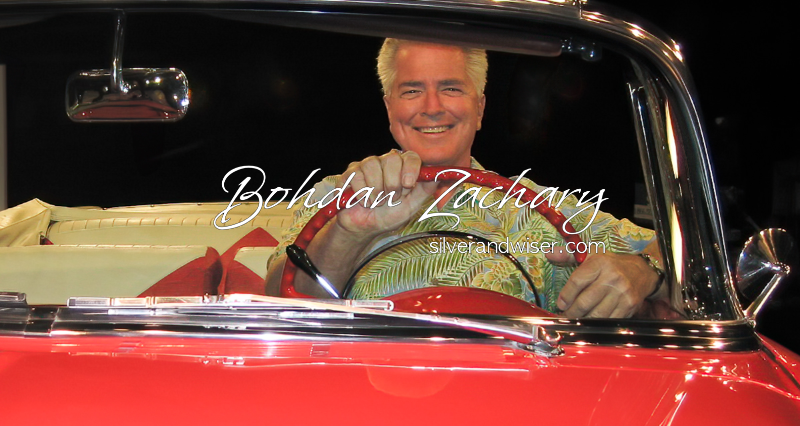
Introducing the Legacy of Huell Howser: A Journey Beyond Expectations
Before I even had the privilege of shaking his hand for the first time, Huell Howser captivated me for being so different from anyone else on TV. I was only weeks into my new life in California (having landed on the West Coast after a decade in Manhattan) I stumbled onto this larger-than-life character on TV who reminded me of the unique and larger-than-life personalities I worked with at WNBC/New York: Jack Cafferty; Sue Simmons; Liz Smith; Chauncey Howell; Pia Lindstrom; Katie Kelly; Frank Field; Marv Albert. They were the one-of-a-kind talents who made WNBC’s “Live at Five” daily newscast a hit. New York Magazine put our show on its cover and proclaimed it “The Hottest Show on TV.” Spotting unique talent and dealing with big personalities is something I have been told I am good at.
One fateful evening, after another day in sunny California producing mindless celebrity pap at E! Entertainment, I sank into my couch and tuned in KCET, the Los Angeles PBS station. And there he was, Huell Howser, larger than life and practically jumping through the television monitor. Huell’s booming Southern twang was the first thing I noticed. Next were his production values and style that stood in marked contrast to the dizzying flash-edit celebrity-focused drivel that was the model of what we produced. I remained spellbound while a handheld video camera operator (no Steadicam here) followed Huell as he walked up to the front door of a bungalow home. Huell turned to the off-cameraman and said “Louis, I think we’re here.” (Luis Ferte earned his own spot in broadcasting legend for being Huell’s longtime videographer).When the front door of the crafstman-era home opened, Huell introduced himself to the Esther DeBar, the homeowner who had lived in the mid-Los Angeles neighborhood for decades. “You wrote a letter and said you had a story to tell and that’s why we’re here.” What came next was a half hour done in one continuous shot; no edits, no cutaways, no short snappy soundbites here. The camera followed Huell and the women from the porch (where they talked a good while), next into the house (for another bit of the show) and finally into the backyard where Huell insisted on seeing the 90-year-old persimmon tree the woman had written about in her letter. Huell Howser, the homeowner and her persimmon. Huell's unique talent is that in the nearly half hour he talked to his interviewee, I learned about the woman, her late husband, the life they'd enjoyed in their home, the demographic and socioeconomic evolution of the neighborhood, and the life of that darned citrus tree.The episode ended with Huell thanking the woman and then a simple credits roll while Huell remained in the woman’s yard beneath the tree. I loved it.
WORKING WITH HUELL HOWSER
Little did I know that one day I would be part of the station that was home to Huell Howser and his small but talented production team. You could say I was a fanboy when I met Huell Howser in late summer of 1997 on KCET's Stage A on Sunset Blvd. “Now you need to calm down, it’s just me,” Huell said. I had come to work at the station that produced and aired Huell’s shows - and one of my responsibilities would include producing on-air fundraising. The night I met him, Huell was commanding his television audience at home and also dozens of excited volunteers on the KCET soundstage taking calls during a live pledge drive. I marveled at the success we had when Huell pledged his series about California's Missions. I thought the programs were terrific. Over the course of the episodes, Huell and longtime camera man Luis Fuerte visited all 21 missions that ran along much of what is present-day California. The series later became a staple in schools throughout the state. And the programs resonated with a viewers at a level I'd never witnessed before. The phones just rang and rang and rang and Huell kept talking for hours without taking a break. He didn't need direction nor did he ever accept it. The camera stayed on Huell as he spoke passionately about the mission of public television. Huell raised enormous sums of money during the pledge drive.
But little did I expect him to take me to task when an executive decision I made infuriated him. I took out a repeat of Huell’s pledge programs on the California missions and instead scheduled a new oldies music pledge showed that featured aging rock stars plodding through their one-hit songs. The next morning, I suddenly felt the presence of someone in the room. Even before I looked up I knew it was Huell. There he was, leaning against the doorway. The unplanned meeting went along these lines. "Soooo," he said semi-quietly in his familiar drawl. "Just wondering, how much money did you make last night?" I reported on our revenue from the oldies special. Huell raised his eyebrows and went for the kill. "And how much money did you make when I pledged last weekend." Before I could even look at the report on my desk he announced the amount, down to how many calls we got, the per-minute average, and how many VHS's we'd sold. Huell had trounced every other pledge show we'd aired during our fundraising drive. By the time he was done with his litany, Huell's already-booming voice was decibels louder especially when he asked how many calls we'd received from viewers upset that we'd pre-empted his show. I learned my lesson. Huell was right because he knew his audience, KCET's viewers, better than any one of us.
Over the course of my nearly 18-year tenure at KCET, .there were other periodic tough conversations Huell and I engaged in. They all tended to get loud (Huell being the one raising his voice) and then they would end on a good note,with him smiling at me and jovial again. When Huell was happy with you, you knew it.
HUELL HOWSER SPECTACLES
As head of KCET’s programming, I welcomed one of Huell’s most unusual and fun specials: “Mobile America.” For the premier of the show, we went live in the enormous KCET studio in Silver Lake. “Mobile America” is a one-hour documentary where Huell went in search of the history of the RV in America debuted October 24, 2003. The collaboation between Huell (who didn’t know the meaning of the word ‘subtle’) and the incredibly talented KCET art director John Restek led to the KCET soundstage looking and feeling like a California forest complete with an enormous old-style RV in the center of the set. That night, our soundstage resembled a California forest. a terrific special and an unmatched success live pledge event. Because Huell didn’t know the word ‘subtle’, he made sure the “Mobile America” in-studio fundraising event would be a major production.
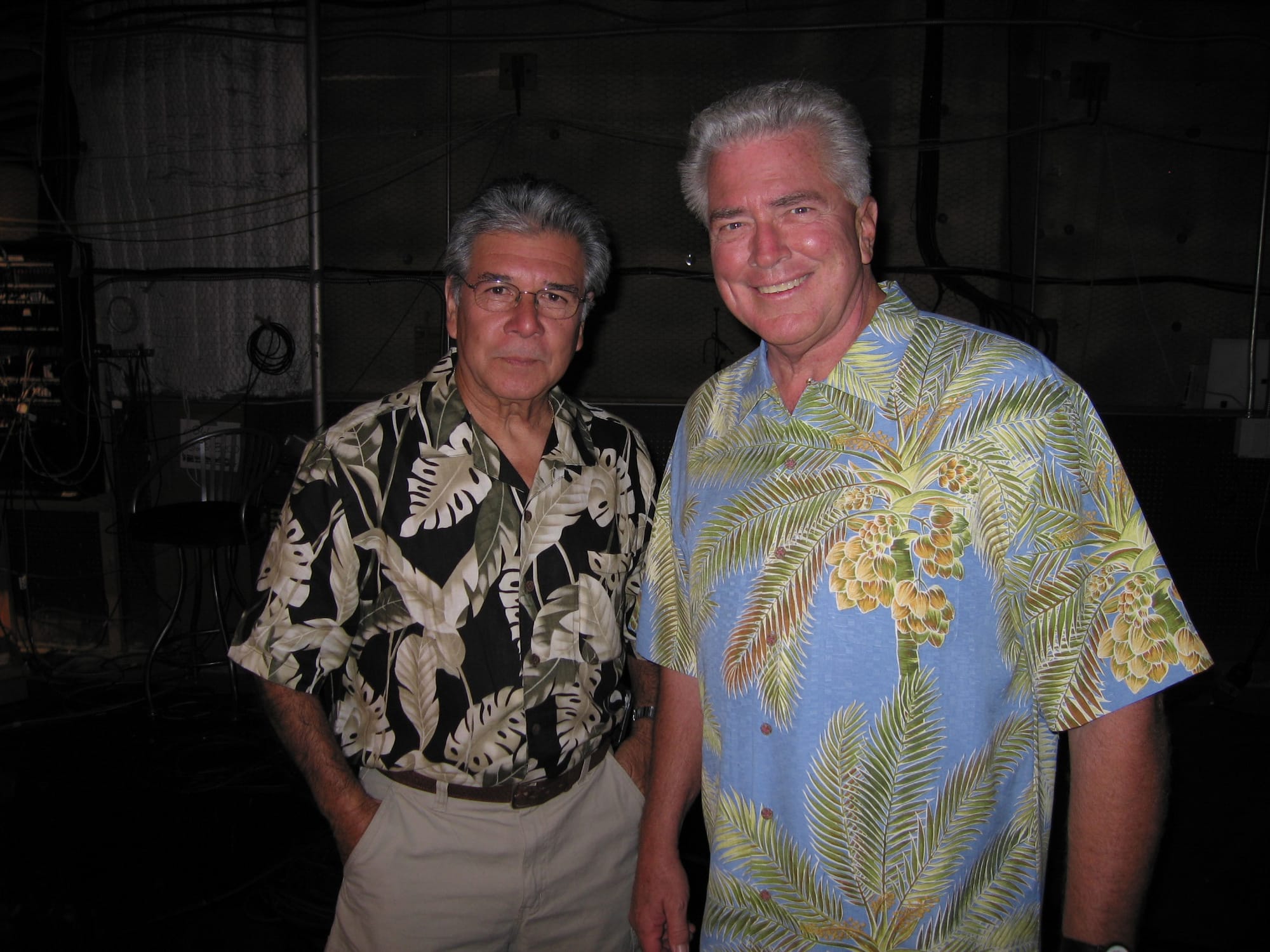
There was even a fire pit to complete the look and feel. The audience loved every part of the night. Once we started our live presentation, with pledge breaks happening every fifteen minutes or so, the analog phones rang nonstop and at fever pitch. I brought my camera to work that day because I wanted to capture the set and Huell doing what he did best- connecting with his fans and viewers. I’m glad to have a photo of Huell with his talented production team - Phil Noyes. Mary Danly; and Harry Pallenberg. Huell insisted someone take my camera so that he and I could be in a photo together; joining us was my longtime friend Jamie Smith. It’s a photo and a special event that resonated with me over two decades later.
PARTING OF THE ROADS
In 2010, when news came out that KCET was leaving the PBS network and was selling its historic lot on Sunset Boulevard to the Church of Scientology, we noticed Huell stopped showing up at his office on the third floor in the administration building. At least not during working hours. He'd pop in late at night for an edit session and to pick up his mail. I knew he was around because on nights when I worked late, I often spotted his familiar SUV outside the building. Hoping to find him just to say hello, I'd run across the KCET lot missing him by mere seconds, catching only the tail lights of Huell’s SUV as he pulled out onto Sunset Boulevard.
Some months later, I was spending the weekend in Palm Springs. I was at a busy Mexican restaurant that was so popular the hostess automatically told anyone arriving there would be an hour or more wait for a table. That night, however, luck was on my side. Suddenly I noticed a very familiar lime green shirt through the thick of the waiting crowd at the bar. As if on cue, Huell turned and waved toward me. The crowd parted for him as he approached us. "My, my, my. Lookee who's here," he said. In that moment, I was reminded how much I missed Huell. Before I knew it, the hostess led Huell, my partner Michael and me to a booth in front room. Huell made sure we ordered because, he told us, he was only staying for a few minutes. He pointedly said he didn’t want to talk shop but wanted to know how life was treating me and Michael. He wanted to know about the home we’d purchased in Palm Springs and promised to visit soon. Even though he'd threatened to sit with us only while he finished his drink, Huell wound up staying for the entire meal. Life was great, he told me. He was enjoying his time in the desert where he owned two residences. That's the most he divulged about himself. In Huell style, he turned the tables and slipped into his interviewer role; Michael and I were now the interviewees. I stopped his ‘interview’ and in my sincerest tone, I tried to express my indebtedness to all I had learned through his adventures. Typical Huell; he demured and quickly changed the topic. Then he wished us well and was gone.
HUELL'S DREAMY FAREWELL
On New Year’s Eve, I was asleep before midnight. For some reason, I had felt unsettled all that day. Something bothered me about what 2013 had in store. This is exactly how I remember the moment I knew Huell had died. He appeared in my dream. Out of the blue, for no reason. I'd not watched his show for weeks nor thought about him. In my dream, I was in New York City with Huell and he was interviewing me about the place I called home for a decade before moving to California. The dream was just like a Huell episode - one continuous shot. Huell and I walked the streets of Manhattan and he kept telling me I needed to focus on what mattered to me most and what made me the happiest. I told Huell he was interviewing me and he needed to stop. I caught him. He showed me that big smile. The last thing he said was "I'm going along now. You be well." He embraced me, shook my hand and then we parted.I awoke from that dream struck by its intensity. And then it became crystal clear.
Huell Howser passed away in his home in Palm Springs on January 7, 2013
The news of Huell's untimely departure shook us all to the core. Yet, amidst the sorrow, we were left with an invaluable gift — the incredible body of work he had produced. From the very inception of "California's Gold" in 1991, Huell's creations have stood as a testament to his one-of-a-kind approach and indelible impact. One of Huell’s final acts was the donation of his archives to Chapman University. (More on those archives can be found at this link). Those video episodes stand the test of time and cement his place in contemporary history. Even before his death. Huell Howser had become such a cultural icon that Matt Groening (the brilliant creator of The Simpsons) made Huell Howser a character on one of the episodes of The Simpsons (to be precise, Huell voiced himself in the season 21 episode "Oh Brother, Where Bart Thou?”).I recently came upon Huell Howser’s star on the Palm Springs Walk of Fame. I stood next to the plaque and suddenly memories of a man I’ll never forget flooded me with happiness.
Member discussion